زبان یہاں تبدیل کریں ↓
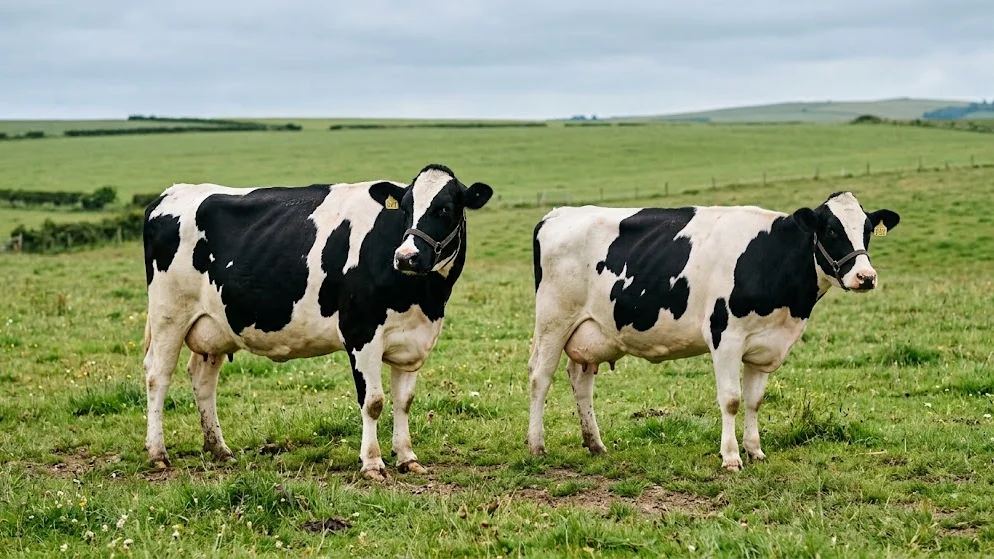
Anyone who has raised Holstein Friesian cattle in Punjab knows that no two cows in the herd are quite the same.
Some animals are visibly taller and heavier at the withers; others, even from the same bloodline, stay comparatively smaller throughout their productive life.
This difference in body size is not just a matter of appearance — it directly changes how much feed a cow needs, what kind of ration suits her best, and how efficiently she converts that feed into milk.
Understanding this relationship helps a farmer avoid two common and costly mistakes: underfeeding a large, high-producing cow (which shows up as weight loss, poor fertility, and falling milk yield) and overfeeding a smaller-framed animal (which wastes feed money and can lead to over-conditioning).
What “Size” Actually Means in a Holstein Friesian Cow
When we talk about size in dairy cattle, we mean body weight and skeletal frame — not just height.
A mature Holstein Friesian cow can vary quite widely in weight depending on genetics (the bull and cow lines behind her), and on how well she was fed and managed as a calf and heifer.
Under good rearing conditions, mature Holstein cows commonly range from around 500 kg to over 650 kg, with some large-framed, well-grown animals going higher still.
In many Pakistani commercial herds, average mature weights tend to sit toward the lower-to-middle part of this range, largely because of heat stress and variable forage quality during rearing, which can restrict a heifer from reaching her full genetic frame potential.
This matters because feed requirements are calculated in relation to body weight — not breed name alone.
Two cows can both be “Holstein Friesian” and still need noticeably different daily rations if one weighs 480 kg and the other weighs 620 kg.
Bigger Cows Need More Feed Just to Maintain Themselves
Every cow, regardless of how much milk she gives, needs a baseline amount of energy and protein simply to keep her body functioning — this is called the maintenance requirement.
It covers basic metabolism, movement, digestion, and keeping the body warm (or, in Punjab’s summers, coping with heat).
Maintenance requirement rises with body weight, so a heavier cow needs more total feed even before she produces a single litre of milk.
This is one reason why two cows giving the same amount of milk are not equally “efficient” — the smaller-framed cow is often putting a larger share of her feed directly into milk production, while the larger cow is spending more of it just maintaining her bigger body.
This doesn’t mean bigger cows are a poor choice; it simply means their feeding programme has to account for this higher baseline cost, especially during the dry period and early lactation when milk yield alone doesn’t justify the extra feed unless it’s genuinely needed for body maintenance and the coming lactation.
Dry Matter Intake Scales With Body Size — and With Milk Yield
Feed is generally measured in terms of dry matter intake (DMI) — the actual dry weight of feed a cow eats per day, once water content is removed.
As a rough working guide, lactating Holstein cows eat somewhere in the range of 2.5–4% of their body weight in dry matter per day, with the exact figure depending on stage of lactation, milk yield, forage quality, and heat stress levels.
A larger cow has a larger rumen and generally a higher physical intake capacity, meaning she can eat more total kilograms of feed.
But intake isn’t driven by frame size alone — a high-yielding cow of moderate size will often eat more, relative to her weight, than a large-framed cow giving less milk, because her body is drawing heavily on nutrients to support milk synthesis.
In practice, both body weight and milk yield need to be considered together when working out how much to feed, rather than using a single number for “a Holstein cow.”
A Bigger Rumen Means More Forage Capacity — Which Matters in Punjab
One practical advantage of a larger-framed cow is rumen capacity. A bigger rumen can process a larger volume of roughage, which is useful in a system like Punjab’s, where forage crops — berseem in winter, and maize or sorghum green fodder or silage in summer — are usually more cost-effective than concentrate (wanda) as a source of bulk feed.
Wheat straw is often included as a low-cost filler roughage, particularly when green fodder is scarce, but because it is high in fibre and low in energy and protein, it needs to be balanced with better-quality forage and concentrate rather than fed as the main ration component.
That said, forage capacity is not unlimited even in a large cow, and during peak lactation, when energy demand is highest, the ration usually needs a higher proportion of concentrate relative to bulk roughage to meet energy needs without overloading the rumen with fibre the cow can’t process fast enough.
Growing Heifers: Feed Needs Change as the Frame Develops
Feed requirements linked to size are not only about mature cows — they matter just as much, if not more, during the heifer-rearing period, because this is when the animal’s mature frame size is being determined.
Feeding heifers is generally planned around a target growth rate (commonly cited around 700–800 grams of body weight gain per day for Holstein heifers, though this varies with breed lines and management goals) so they reach breeding weight — typically around 55–60% of expected mature body weight — at an appropriate age, and calve at around 24 months at close to 85% of mature weight.
Underfeeding heifers delays puberty and results in smaller mature cows with lower lifetime milk potential.
Overfeeding, particularly with too much energy-dense concentrate, can cause excess fat deposition in the udder tissue, which may reduce future milkproducing capacity — so heifer feeding is really about steady, correctly-paced growth rather than maximum growth.
Body Condition Matters as Much as Frame Size
Frame size (skeletal size) and body condition (fat cover) are two different things, and both affect feed planning. Two cows with the same frame size can carry very different amounts of body condition depending on how they were fed in the previous lactation and dry period.
A cow that calves down too thin will struggle to meet early lactation energy demands from feed alone and will mobilise body fat, increasing her risk of metabolic issues.
A cow that calves down over-conditioned faces a higher risk of difficult calving and reduced feed intake after calving. This is why body condition scoring, alongside body weight, is a more reliable guide to feeding than frame size or breed assumptions alone.
Size, Heat Stress, and Feed Intake in Punjab’s Climate
Larger-bodied cows generate more metabolic heat as a by-product of digestion and milk production, and they have comparatively less body surface area relative to their body volume, which makes it harder for them to dissipate that heat.
In Punjab’s hot summer months, this means larger cows are often the first to show reduced feed intake and lower milk yield under heat stress, since a cow naturally eats less to reduce internal heat production when she is struggling to keep cool.
Managing this well usually means providing shade, adequate drinking water, and cooling arrangements such as fans or wetting systems where feasible, alongside feeding more energy-dense rations (relying more on good-quality forage and balanced concentrate, less on bulky, low-energy roughage) during the hottest months, since the cow is physically eating less bulk overall.
Practical Feeding Approach for Holstein Herds in Pakistan
Rather than feeding by a fixed rule of thumb, a workable approach for Pakistani Holstein herds usually involves:
- Estimating or recording actual body weight (using a weighband or scale where available) rather than guessing from breed or appearance.
- Adjusting the forage-to-concentrate ratio based on the cow’s weight, milk yield, and stage of lactation — heavier maintenance needs and higher yields generally call for a greater share of concentrate (wanda), while lower-yielding or dry cows can be maintained more on forage such as berseem, maize/sorghum fodder, or silage, supplemented with straw where forage is limited.
- Including a mineral mixture in the ration, since larger, higher-yielding cows have proportionally higher mineral and vitamin demands that forage alone, especially wheat straw-heavy diets, usually cannot meet.
- Using a Total Mixed Ration (TMR) approach where feasible, mixing forage, concentrate, and minerals together rather than feeding them separately. This is particularly useful for larger cows and high-producing animals, as it prevents selective feeding (where a cow picks out the concentrate and leaves the straw or lower-quality forage) and keeps rumen fermentation more stable.
- Re-assessing the ration as heifers grow and as cows move through lactation stages, since a ration suited to a 400 kg heifer or a cow at peak lactation will not suit the same animal a few months later.
Common Mistakes to Avoid
A frequent error is feeding by breed reputation rather than by the individual animal — assuming that because a cow is a Holstein Friesian, a standard quantity of wanda and fodder will suit her, regardless of her actual weight, yield, or condition.
Another is failing to adjust concentrate levels as heifers grow, which can either stunt growth or lead to over-conditioning.
A third is pushing concentrate too high relative to forage in an attempt to boost milk yield in larger cows, without accounting for the fibre the rumen needs to function properly — this raises the risk of digestive upset and acidosis rather than improving production.
The Practical Takeaway
Size affects feed requirements in several linked ways: heavier cows need more feed for maintenance alone, have greater intake capacity due to a larger rumen, and generally require careful attention to condition and heat management given Punjab’s climate.
But size alone is not a complete guide — milk yield, stage of lactation, body condition, and forage quality all interact with body size to determine the right ration.
The most reliable approach is to feed the individual animal based on her actual weight, yield, and condition, rather than relying on a single figure that supposedly applies to “a Holstein Friesian cow” in general.